

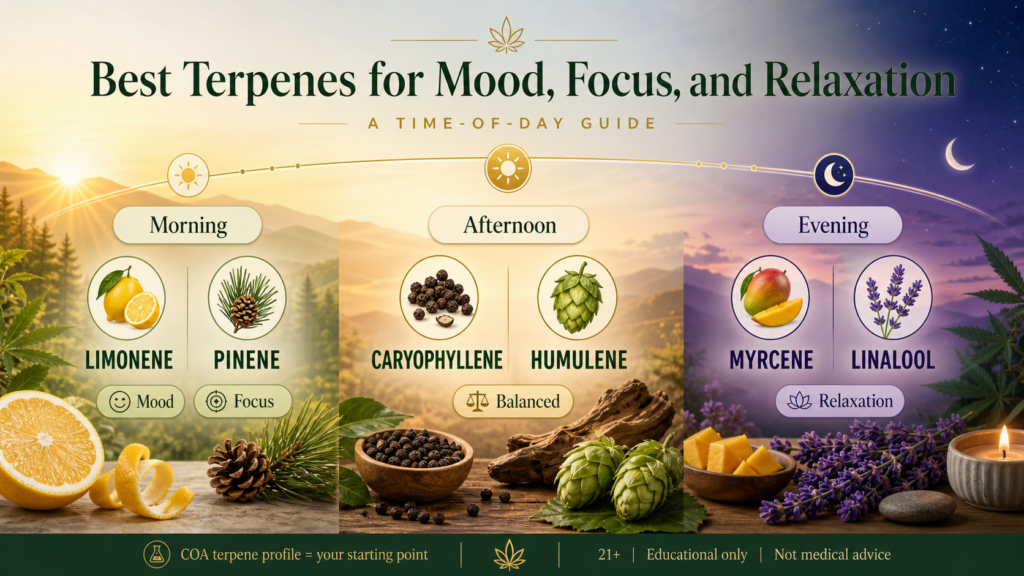
- Different terpenes carry different reported effect profiles: earthy, citrusy, floral, piney.
- Myrcene and linalool are commonly associated with evening and relaxation-focused use.
- Limonene and pinene are often linked to daytime, uplifting, and focus-oriented experiences.
- Caryophyllene is uniquely versatile: it binds CB2 receptors and works well across different moments.
- Your terpene profile chart is the starting point for mood-based selection.
- No terpene guarantees a specific outcome. Always consult a medical professional for personal guidance.
21+ Only. This article is for educational purposes only and does not constitute medical advice. Consult a licensed medical professional before making health-related decisions.
Your alarm goes off. The question isn’t just what strain to reach for. It’s what the plant’s chemistry is built for at that moment.
Cannabis is not one-size-fits-all. Neither are terpenes. The best terpenes for relaxation are not the same as the best terpenes for focus. Understanding which types of terpenes suit which moments is one of the most practical upgrades you can make as a consumer.
The same six terpenes covered in GreenPharms’ terpene profile chart show up differently depending on which one dominates and how it interacts with the rest of the plant. Some profiles feel activating. Some feel settling. Most land somewhere in between. If you haven’t read the foundational terpenes and their effects guide yet, start there. Then come back here.
Here’s how to think about terpenes. Not just by name, but by when to reach for them.
Why Terpenes and Their Effects Vary by Time of Day
Terpenes interact with cannabinoids through what researchers call the entourage effect. The whole plant delivers a more nuanced experience than any single compound on its own. The dominant terpene in a product’s profile shapes much of that nuance.
Some terpenes tend toward activation. Others lean toward settling. This isn’t a guarantee. Individual body chemistry, tolerance, dose, and product format all play a role. But as a general framework, time-of-day terpene matching gives you something more useful than THC percentage alone.
Think of it as reading the room. Morning calls for different chemistry than midnight.
With that context in place, let’s go through the day.
Best Terpenes for Morning and Focus: Limonene and Pinene
Morning / Daytime
Limonene and Pinene
Limonene smells like a freshly cut citrus rind. Bright. Sharp. Unmistakable. It’s a primary compound in the oils of lemon, orange, and grapefruit peel. In cannabis, it’s associated with uplifting, mood-elevating character.
Pinene carries the scent of a pine forest after rain. It’s one of the most widespread terpenes in nature, found in pine trees, rosemary, and fresh basil. In cannabis, it’s often linked with a clearer, more alert quality compared to heavier, earthier profiles.
Neither terpene is a stimulant. But consumers who prefer a lighter, brighter cannabis experience in the morning tend to gravitate toward limonene- and pinene-dominant products. Strains like MAC, Wedding Cake, and Do-Si-Dos run high in limonene. Gelato and Fruity Pebbles are strong pinene options. Check the cannabis strain guide at GreenPharms for more on which cultivars carry these profiles.
When shopping, pull the COA and look at the top two or three terpenes by percentage. If limonene or pinene leads the list, you’re looking at a morning-leaning profile.
Afternoons call for something different.
Best Terpenes for Daytime and Focus: Caryophyllene and Humulene
Afternoon / Social / Creative
Caryophyllene and Humulene
Caryophyllene is spicy. Peppery. It hits like a freshly cracked peppercorn. It appears in black pepper, cloves, basil, and oregano. In cannabis, it brings a grounding quality: present, but not heavy.
What makes caryophyllene stand apart from every other terpene is its biology. It’s the only terpene known to directly bind CB2 receptors, the same receptors cannabinoids interact with in the body’s peripheral tissues and immune system. That gives it a profile that sits somewhere between a standard terpene and a cannabinoid.
Humulene is earthy, woody, and slightly hoppy (it’s also a major terpene in hops). It pairs naturally with caryophyllene, and the two appear together often in strains like OG Kush and Headband. The combination tends to feel grounding without tipping into sedation, which makes it useful for afternoon creative work or a relaxed social setting.
Expert Insight
Caryophyllene Is the Most Underrated All-Day Terpene
Most terpene guides slot caryophyllene into a single effect category and move on. That misses what makes it genuinely unusual. According to ScienceDirect, it is the only terpene known to directly bind CB2 receptors, the same receptors cannabinoids interact with in the immune system and peripheral tissues. That means caryophyllene can contribute to a balanced, grounding experience without the heavier sedation associated with high-myrcene profiles. For consumers who want something functional in the middle of the day (calm, not couch-locked), a caryophyllene-dominant product is the most underutilized option on the menu. Look for it in OG Kush, Sour Diesel, and Skywalker OG.
As the day winds down, so does the terpene profile you probably want.
Best Terpenes for Relaxation and Sleep: Myrcene and Linalool
Evening / Wind-Down / Before Sleep
Myrcene and Linalool
Myrcene is the most common terpene in cannabis. Full stop. According to research in Frontiers in Nutrition, myrcene is not only the most prevalent terpene across cannabis strains but also the most likely to be the dominant compound in any given plant. It carries an earthy, musky aroma: think ripe mango, herbal hops, and damp soil.
Myrcene has long been used in traditional herbalism as a sleep aid. NIH-published research points to its sedative-adjacent properties as a likely reason. High-myrcene strains include Blue Dream, Granddaddy Purple, and Grape Ape. These are the ones most consumers reach for at the end of the day.
Linalool is floral and soft. It’s the terpene that gives lavender its character. Outside cannabis, it appears in coriander, birch bark, and hundreds of floral plant species. Research on linalool has demonstrated promise for anxiolytic and antidepressant properties in preclinical studies. Strains like Gushers, Ice Cream Cake, and Mimosa run high in linalool.
A product that leads with both myrcene and linalool on the COA is about as evening-forward as a terpene profile gets.
That brings us to the full picture in one place.
Terpene Profile Chart: Best Terpenes by Mood, Time, and Effect
Use this as your at-a-glance guide the next time you’re browsing a menu or reviewing a COA.
| Time of Day | Mood / Intent | Terpene | Aroma | Example Strains |
| Morning | Uplifted, bright, motivated | Limonene | Citrus, fresh | MAC, Wedding Cake, Do-Si-Dos |
| Morning | Alert, clear-headed, focused | Pinene | Pine, resinous | Gelato, Fruity Pebbles, Paris OG |
| Afternoon | Grounded, balanced, functional | Caryophyllene | Spicy, peppery | OG Kush, Sour Diesel, Skywalker OG |
| Afternoon | Calm, social, creative | Humulene | Woody, earthy, hoppy | Super Lemon Haze, White Widow, Headband |
| Evening | Relaxed, unwinding, settling | Myrcene | Earthy, musky, herbal | Blue Dream, Granddaddy Purple, Grape Ape |
| Evening / Night | Calm, soft, pre-sleep | Linalool | Floral, lavender | Gushers, Ice Cream Cake, Mimosa |
This chart pairs directly with GreenPharms’ full terpene profile chart, which breaks down each terpene in more detail alongside the strains that carry them.
Now the question is: how do you actually find this on a label?
How to Use a Terpene Profile Chart When Shopping for Cannabis
A Certificate of Analysis, or COA, is a lab report that shows what’s actually in a cannabis product. Most licensed Arizona dispensaries make COAs available in-store or on request.
Look for the terpene panel. Not every COA includes one, but many do. The terpenes will be listed by percentage, usually from highest to lowest. The top one or two on that list are driving the profile.
A few practical tips:
- Look for at least 1 to 2 percent total terpenes. Below 0.5 percent, the aroma and profile character will be noticeably thinner.
- Match the dominant terpene to your time-of-day chart. If myrcene leads at 0.8 percent and linalool follows at 0.5 percent, you’re looking at an evening product.
- Ask your budtender. The team at GreenPharms grows and processes in-house in Mesa, Arizona. They know what’s on the shelf because they made it. That’s a different conversation than you’ll get most places.
Frequently Asked Questions About Terpenes and Mood
What terpene is best for relaxation?
Myrcene and linalool are the two terpenes most commonly associated with relaxation. Myrcene is the most prevalent terpene in cannabis and has been studied for sedative-adjacent properties. Linalool, also found in lavender, has been researched for calming and anxiolytic effects. Both appear most often in indica-leaning strains like Granddaddy Purple, Gushers, and Ice Cream Cake. This article is educational only. Consult a medical professional for personal guidance.
What terpene is best for focus and energy?
Limonene and pinene are the terpenes most often linked to uplifting, clear-headed, and focus-oriented cannabis experiences. Limonene carries a bright citrus aroma and is commonly associated with mood elevation. Pinene, which smells like pine and rosemary, is often connected with alertness. Look for these as dominant terpenes on a COA when shopping for a daytime product.
Which terpenes are best for daytime use?
Limonene, pinene, caryophyllene, and humulene are the four terpenes best suited to daytime use. Limonene and pinene tend toward uplifting, energizing profiles. Caryophyllene and humulene are more grounding and balanced without the sedation associated with evening terpenes like myrcene and linalool. Check a product’s COA terpene panel to see which ones lead the profile before buying.
What is the best terpene for anxiety?
Linalool is the terpene most studied for anxiety-related properties. NIH-published research has examined its potential as an anxiolytic. Caryophyllene, which binds CB2 receptors like a cannabinoid, is also associated with a calming, grounding quality. Neither terpene is a treatment for anxiety. Always consult a licensed medical professional for mental health guidance before using cannabis.
Do terpenes actually affect how cannabis makes you feel?
Research suggests terpenes play a role in shaping the cannabis experience through what is called the entourage effect, where terpenes and cannabinoids interact together. Terpene percentage, individual body chemistry, dose, and product format all influence the outcome. No terpene guarantees a specific effect, but understanding terpene profiles gives you a more informed starting point than THC percentage alone.
How do I find terpene information on a cannabis product?
Look for the Certificate of Analysis, or COA, for any product you’re considering. A COA with a terpene panel lists each terpene by percentage from highest to lowest. The top one or two terpenes drive most of the product’s aroma and sensory character. Ask your budtender to pull the COA before you buy. At GreenPharms in Mesa, Arizona, the team can walk you through what’s on the shelf.
The Bottom Line on Terpenes, Mood, and Time of Day
The best terpenes for relaxation are not the same as the best terpenes for focus. That’s the whole point.
Myrcene and linalool settle you into evenings. Limonene and pinene are the types of terpenes that suit mornings and active hours. Caryophyllene and humulene hold the middle of the day without pulling you toward sedation. That’s your terpene profile chart in action.
The more you know about terpenes and their effects, the less you’re guessing at the counter. The chart gives you a framework. The COA gives you the data. The budtender gives you the context. Put all three together and you start choosing with real information.
Disclaimer: This content is for educational purposes only and is intended for adults 21 and over in accordance with New Jersey and applicable state law. Nothing in this article constitutes medical advice, a treatment recommendation, or an endorsement of any specific product. If you have specific health questions or conditions, please consult a licensed medical professional before using cannabis products.
Find Your Terpene Match at GreenPharms
GreenPharms grows, processes, and sells in-house in Mesa, Arizona. The team knows the terpene character of what’s on the shelf, because they built it. Explore the full breakdown at GreenPharms’ terpene profile guide, or come in and ask a budtender to match your moment to the right profile.