
Key Takeaways
- RSO is a thick, dark, full-spectrum cannabis oil sold in a syringe.
- The oil is decarboxylated, so it is already active when you eat it.
- The syringe is a dispenser, not a medical device.
- RSO keeps plant compounds that distillate strips out during refining.
- Arizona heat thins RSO fast, so storage location matters.
- Every legal RSO syringe in Arizona carries lab-tested potency on the label.
You walk up to the concentrate case and spot something odd. It is not a jar. It is not a cart.
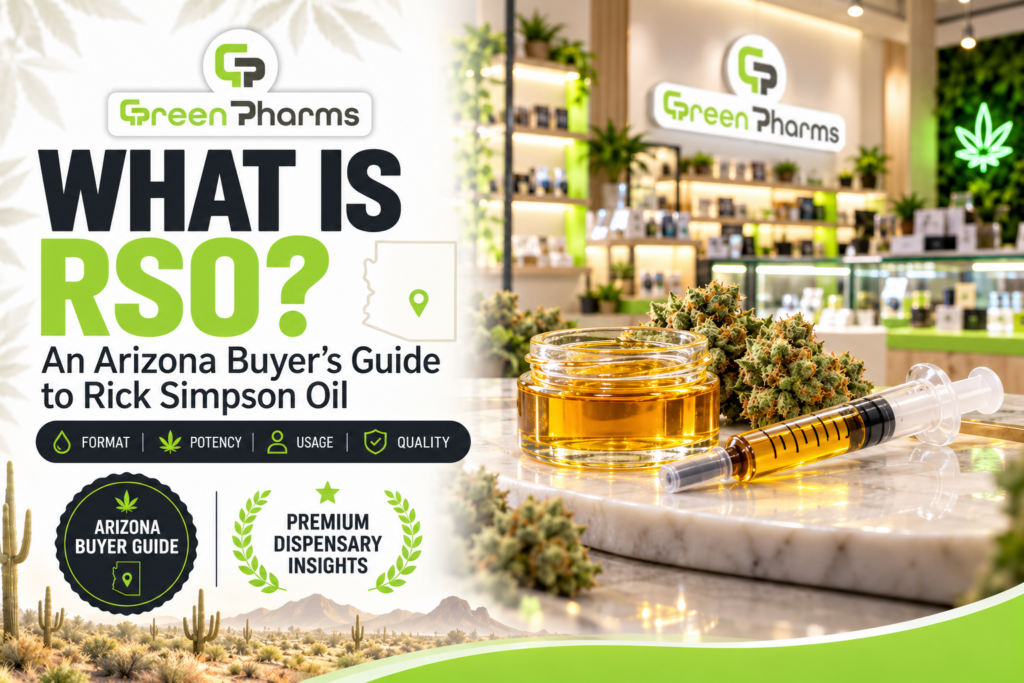
It is a plastic syringe filled with something dark and thick as tar.
That is RSO, and the label tells you almost nothing useful. Most shoppers walk right past it. That is a shame, because RSO is one of the most misunderstood items in the entire case. It is also one of the most versatile. This guide covers what the oil actually is, how it gets made, and what to check before you buy. If you are still mapping out the menu, our guide to cannabis product types breaks down every category we carry.
This article is for adults 21 and over. It is educational only and is not medical advice.
So what separates this syringe from everything else in the case? Start with the oil itself.
What RSO Actually Is
RSO stands for Rick Simpson Oil. The name comes from a Canadian man who popularized the format in the 2000s. He shared his production method publicly, and the name stuck.
Here is the part most people miss. RSO is not defined by one extraction method.
It is defined by three traits working together. The oil is full-spectrum. It is decarboxylated. It is packaged in a syringe.
Full-spectrum means the extract keeps the wider mix of plant compounds. Producers do not refine the oil down to a single cannabinoid. That is why RSO looks dark brown or near black instead of clear gold.
Most RSO today gets made with ethanol. The solvent strips cannabinoids and other compounds from the plant material. Producers then purge the solvent off with gentle heat.
That heat does double duty, and the second job is the important one.
Why Decarboxylation Is the Whole Point
Raw cannabis does not contain much THC. It contains THCA, the acid form.
THCA does not produce the effects people associate with THC. Heat changes that. The process is called decarboxylation, and it converts the acid form into the active one.
Smoking does this instantly with a flame. Vaping does it with a heating coil.
Eating raw concentrate does none of that.
This is where RSO separates from every other product in the concentrate case. Shatter, badder, and live resin are not fully decarboxylated. Spread raw shatter on toast and you waste it. RSO arrives already activated, which is why you can simply eat it.
Researchers have studied this conversion closely. A review of acidic cannabinoid decarboxylation published through the National Institutes of Health shows the reaction depends on both temperature and time. Push too hot and you degrade the product. Go too cool and conversion stalls.
Good producers control that window tightly. That control is exactly what you are paying for.
RSO Compared to Other Concentrates
The case can blur together fast. This table sorts it out.
| Product | Appearance | Decarbed? | Typical Use |
| RSO | Dark, thick, tar-like | Yes | Eaten, added to food, applied to a joint |
| Distillate | Clear to light gold | Yes | Carts, edibles, infused pre-rolls |
| Live Resin | Amber, sticky, sauce-like | No | Dabbing, carts |
| Live Rosin | Light, creamy, solventless | No | Dabbing, premium carts |
Notice the pattern. The two decarbed products are the ones built for eating.
If the resin and rosin column raised questions, our post on the difference between resin and rosin covers that split in detail.
That still leaves the strangest part of the package. Why a syringe?
Why RSO Comes in a Syringe
The syringe confuses people constantly. Nobody injects RSO. Ever.
The syringe solves a packaging problem.
RSO is thick and sticky at room temperature. It clings to glass and refuses to pour. Scooping it out of a jar wastes product and makes a mess.
A plunger fixes all of that. It pushes the oil out cleanly. The barrel also carries printed measurement markings, which lets you portion the oil consistently.
That is the whole reason. The syringe is a dispenser and a measuring tool, nothing more.
Arizona adds one more layer worth knowing.
What the Label Tells You
Arizona regulates adult-use cannabis through the state health department. Under the Adult Use Marijuana Program, licensed establishments must verify age and make product testing results available before a sale.
For an RSO syringe, that means real numbers on the package. Total cannabinoid content. Batch identifiers. Testing data you can ask to see.
Read those numbers before anything else. RSO syringes vary widely in strength between brands and batches.
Expert Insight
The Temperature Trick Nobody Tells You About
Budtenders see the same complaint every summer. A customer says their syringe “went bad” because the oil turned runny and leaked. The oil is fine. RSO viscosity swings hard with temperature, and a Mesa car in July can hit 130°F. That heat thins the oil to the consistency of syrup, and it will creep out of an uncapped tip. The reverse problem shows up in winter or a cold fridge, when the plunger will barely move at all. The fix is the same in both directions. Store the syringe capped and upright in a cool, dark cabinet, then warm the barrel briefly in your hands before you use it. Heat also degrades cannabinoids over time, which our post on Arizona heat and cannabis covers across every product type.
That covers storage. Now for the question people actually ask.
How People Use RSO
RSO is unusually flexible. Here are the four common approaches.
- Eaten directly. The simplest route. Portion the oil and swallow it.
- Added to food or drink. Stir it into something with fat, like peanut butter or yogurt. Fat helps carry the oil.
- Applied to flower. Some people run a thin line along a joint or pre-roll before smoking it.
- Applied topically. Some brands market RSO-style oils for external use. Check the label, since not every syringe is formulated for skin.
Can you dab RSO? Technically yes, though few people do. The oil is already decarbed and contains more residual plant material than a dab-focused extract. The flavor suffers badly.
Can you vape RSO in a standard cart? No. It is far too thick for a 510 cartridge and will clog the wick.
Timing works differently depending on the route, and this trips people up.
Onset Runs on Two Different Clocks
Eating RSO means it passes through your digestive system and liver first. Inhaling it does not.
That difference is large. A clinical review published through the National Institutes of Health reports that orally consumed THC has roughly 4 to 12 percent bioavailability, with onset between one and three hours and effects lasting six to twelve hours. Inhaled cannabis reaches roughly 10 to 35 percent bioavailability, with onset inside ten minutes and a much shorter duration.
Eaten RSO follows the slow clock. Smoked RSO follows the fast one.
Plan around whichever route you choose. Your budtender can walk you through the specific product in front of you.
Frequently Asked Questions
Is RSO the same thing as distillate? RSO is not the same as distillate. Both are decarboxylated, but RSO stays full-spectrum and dark. Distillate gets refined down until it is clear and stripped of most other plant compounds.
Is it safe to smoke RSO? Smoking RSO is possible, and some people apply a thin line to a joint. It is not designed for dabbing or for standard vape cartridges, since the oil is thick and contains more plant material.
Is RSO legal to buy in Arizona? RSO is legal for adults 21 and over at licensed Arizona dispensaries. The state requires age verification and access to product testing results before any sale.
Are all RSO syringes the same strength? RSO syringes are not standardized. Potency varies by brand and by batch. Always read the total cannabinoid figure printed on the label before buying.
Is RSO an FDA-approved product? RSO is not FDA approved. The FDA has not approved botanical cannabis for any medical use. State-legal cannabis operates outside that federal approval process.
Conclusion
RSO looks intimidating in the case, and the syringe does it no favors. Strip away the packaging and it is straightforward. It is a full-spectrum oil, already activated by heat, packed in a container built for portioning.
Once you understand those three traits, the whole category makes sense.
This article is educational and intended for adults 21 and over. It is not medical advice and makes no health claims. Talk with a licensed medical professional about your personal situation before making any health-related decision.
Ready to See RSO in Person?
The easiest way to understand RSO is to look at a real syringe and read a real label. Stop by GreenPharms in Mesa and ask a budtender to walk you through the concentrate case. You can also browse our Mesa menu online before you visit, or explore the full product lineup if you want to compare categories first.menu online first, or compare product categories if you are still deciding between edibles and something else.