
If you’ve ever wondered why some cannabis products are available at gas stations while others require a medical card or trip to a licensed dispensary like GreenPharms, you’re not alone. The distinction between hemp and cannabis might seem arbitrary, but it’s rooted in federal law, political history, and a single number: 0.3 percent.
Disclaimer: This article is for educational purposes only and does not constitute medical or legal advice. Cannabis and hemp products have not been evaluated by the FDA and are not intended to diagnose, treat, cure, or prevent any disease. Consult with a qualified healthcare professional before using any cannabis or hemp product, especially if you have a medical condition or take medications.
What Makes Hemp Different from Cannabis?
Here’s where things get interesting. Hemp and cannabis (often called marijuana) are actually the same plant species: Cannabis sativa L. The federal government doesn’t distinguish them based on how they look, where they’re grown, or even their genetic makeup. Instead, it all comes down to one chemical compound and a very specific threshold.
The 0.3% THC Threshold
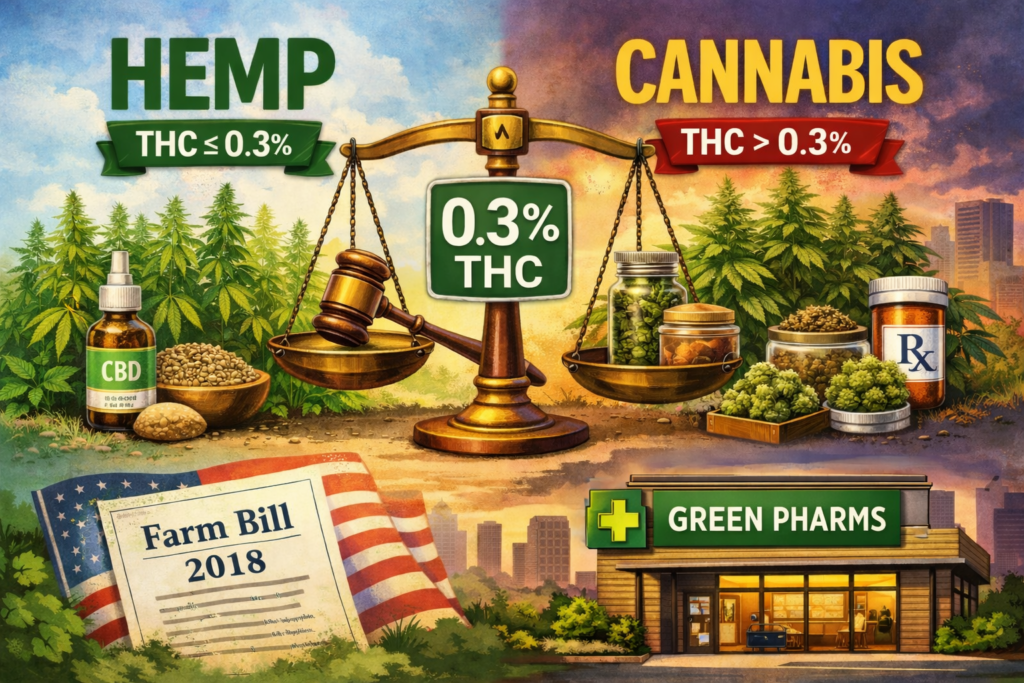
The 2018 Farm Bill established that hemp is cannabis containing no more than 0.3 percent delta-9 THC on a dry weight basis, while anything above that threshold is legally classified as marijuana. This seemingly random number has massive legal implications. Products meeting the hemp definition were removed from the Controlled Substances Act, making them federally legal to grow, process, and sell across state lines.
Cannabis exceeding this threshold remains a Schedule I controlled substance under federal law, despite being legal for medical or recreational use in many states. When you shop at GreenPharms in Mesa, Arizona, you’re purchasing from a state-licensed dispensary operating within Arizona’s regulated cannabis framework, which requires rigorous testing, tracking, and compliance standards.
Understanding Cannabinoids: More Than Just THC
The cannabis plant produces over 100 different cannabinoids, each with unique properties and effects. While THC gets most of the attention, understanding the full spectrum helps explain why legal definitions matter so much.
Delta-9 THC: The Original
Delta-9 tetrahydrocannabinol (delta-9 THC) is the primary psychoactive compound in cannabis. It’s what produces the “high” that cannabis is known for. The 0.3% federal threshold specifically refers to delta-9 THC concentration, which created an unexpected opening in the market.
CBD: The Non-Intoxicating Cannabinoid
Cannabidiol (CBD) is non-psychoactive and found in high concentrations in hemp plants. While CBD products that meet the hemp definition are federally legal under the 2018 Farm Bill, they must still comply with FDA regulations. Many consumers don’t realize that even legal hemp-derived CBD products cannot make medical claims without FDA approval.
The THCA Loophole
Here’s where things get complicated. Tetrahydrocannabinolic acid (THCA) is the precursor to delta-9 THC found in raw cannabis plants. When heated through smoking or vaping, THCA converts to delta-9 THC through a process called decarboxylation. Because the 2018 Farm Bill’s definition focused only on delta-9 THC levels, some cultivators began selling high-THCA flower that technically tested below the 0.3% delta-9 threshold but became intoxicating when consumed.
Delta-8 and Synthetic Cannabinoids
The 2018 Farm Bill’s definition arguably created a loophole for products containing potentially intoxicating cannabinoids other than delta-9 THC, such as delta-8 THC. Delta-8 THC occurs naturally in trace amounts but is typically synthesized from CBD extracted from hemp. Sales of delta-8 THC products generated over $2 billion in 2021 and 2022, demonstrating the massive market that emerged from this legal gray area.
Why These Loopholes Exist
The emergence of intoxicating hemp products wasn’t what lawmakers intended when they passed the 2018 Farm Bill. The legislation aimed to support farmers growing hemp for fiber, seeds, and CBD extraction. However, the specific focus on delta-9 THC concentration left room for creative interpretation.
The Testing Window Problem
Cultivators discovered they could manipulate plant testing by finding strains that don’t express THCA until late in the required 30-day testing window, then testing early to stay below federal limits. Once these plants reached retailers, they developed higher THCA concentrations that converted to intoxicating delta-9 THC when consumed. This technical compliance with testing requirements while delivering intoxicating products exemplifies how loopholes develop.
Market Demand in Prohibition States
A federally funded study found that people living in states without legal marijuana markets were more than twice as likely to have used delta-8 THC, suggesting that prohibition may inadvertently promote alternative cannabinoid use. When consumers can’t access regulated cannabis products from licensed dispensaries like GreenPharms, they often turn to unregulated hemp-derived alternatives available at convenience stores and online retailers.
State-by-State Patchwork Regulations
The federal hemp framework created a baseline, but states have responded with dramatically different approaches. Some states embraced the hemp market, while others moved quickly to close perceived loopholes. Connecticut, for example, tightened hemp regulations in 2024, prohibiting online sales and limiting products to one milligram per serving and five milligrams per container. Meanwhile, other states maintained more permissive frameworks, creating an inconsistent regulatory landscape.
Recent Regulatory Changes: Closing the Gaps
Federal and state regulators have been working to address unintended consequences of the 2018 Farm Bill. Understanding these changes helps explain why the hemp vs. cannabis distinction continues evolving.
The 2025 Hemp Definition Update
In November 2025, new federal legislation redefined hemp to include total THC concentration (including THCA) rather than just delta-9 THC, with a limit of 0.4 milligrams of total THC per container for final hemp-derived products. This significant change closes the THCA loophole and restricts synthetic cannabinoids. The new definition takes effect November 12, 2026, giving businesses time to adjust but fundamentally reshaping the hemp market.
Synthetic Cannabinoid Restrictions
The updated hemp definition explicitly excludes synthetic cannabinoids such as delta-8 and THCA from the definition of hemp, even when derived from legal hemp. This means many popular products currently sold as “hemp-derived” will become federally illegal once the new definition takes effect. The DEA previously stated that THC-O, a synthetic cannabinoid, is a Schedule I controlled substance because it can only be obtained synthetically.
State-Level Crackdowns
States aren’t waiting for federal action. Georgia enacted legislation in 2024 establishing a total THC limit for products, effectively closing the THCA loophole. Iowa placed new limits of 4 milligrams per serving and 10 milligrams per container while prohibiting synthetic cannabinoids and flower intended for inhalation. California has sent hundreds of cease-and-desist orders to hemp-derived cannabinoid businesses, though enforcement remains inconsistent.
Cannabis Rescheduling: Blurring the Lines Further
While hemp regulation tightens, cannabis itself may be moving in a more permissive direction through federal rescheduling efforts.
From Schedule I to Schedule III
In May 2024, the DEA proposed moving marijuana from Schedule I to Schedule III of the Controlled Substances Act. Schedule III substances have accepted medical uses and lower abuse potential than Schedule I or II drugs. President Trump issued an executive order on December 18, 2025, instructing the Attorney General to expedite this rescheduling process.
What Rescheduling Means (and Doesn’t Mean)
It’s crucial to understand that rescheduling to Schedule III is not the same as federal legalization. Cannabis would remain a controlled substance requiring DEA registration and FDA approval for medical use. However, rescheduling would have significant practical effects.
The most immediate change would be eliminating IRS Code Section 280E, which prevents cannabis businesses from deducting normal business expenses. This tax restriction forces state-legal cannabis businesses to pay effective tax rates much higher than other industries. Removal of 280E could significantly reduce costs for licensed dispensaries, potentially making them more competitive with the illicit market.
Rescheduling would also acknowledge cannabis’s medical value at the federal level and potentially ease research restrictions. However, it would not bring state-legal recreational marijuana into federal compliance, and medical products would still require FDA approval to be legally prescribed.
Banking and Interstate Commerce
Many hope rescheduling will solve cannabis banking challenges. Currently, most financial institutions avoid serving cannabis businesses due to federal prohibition. While rescheduling might encourage some banks to reconsider, it wouldn’t automatically resolve all banking access issues without additional regulatory clarity or legislation.
Interstate commerce would also remain prohibited under Schedule III. Each state’s cannabis market would continue operating independently, preventing GreenPharms from shipping products across state lines even to other states where cannabis is legal.
Why Quality and Testing Matter More Than Ever
The complex legal landscape makes third-party testing and quality assurance critical for consumer safety. When you purchase from GreenPharms, you’re accessing products that undergo rigorous testing protocols required by Arizona’s cannabis program.
The Labeling Problem
A study examining 53 commercial hemp samples found that 49 were incorrectly labeled as hemp because they technically fit the federal classification of marijuana based on total THC concentration. This demonstrates that consumers cannot rely on labels alone when purchasing hemp or cannabis products.
Licensed dispensaries like GreenPharms operate under strict testing requirements that verify cannabinoid content, screen for contaminants, and ensure products match their labels. State-licensed cannabis testing goes far beyond what’s required in the largely unregulated hemp market.
Understanding Certificates of Analysis
Reputable cannabis and hemp businesses provide Certificates of Analysis (COAs) from independent laboratories. These documents show exact cannabinoid profiles, potency levels, and contaminant testing results. When shopping at GreenPharms, you can access testing information for products, giving you confidence in what you’re purchasing.
The Risk of Unregulated Products
Hemp products sold outside regulated cannabis systems often lack proper testing and oversight. Products may contain higher THC levels than labeled, unexpected contaminants, or synthetic additives not disclosed to consumers. The FDA has issued warnings about hemp-derived cannabinoid products and their potentially harmful effects, particularly regarding products packaged similarly to existing snack brands that may appeal to children.
Finding Quality Cannabis Products in Arizona
Arizona’s regulated cannabis market provides consumer protections that unregulated hemp products simply cannot match. Here’s what sets licensed dispensaries apart.
GreenPharms’ Commitment to Quality
GreenPharms operates as a vertically integrated cannabis company, meaning we control cultivation, processing, and retail sales. This allows us to maintain quality standards throughout the entire production process. Our Mesa dispensary offers a curated selection of flower, concentrates, edibles, vapes, and topicals from trusted brands like Verano (the essence), Vital Dispensary products, and Ogeez, alongside our own house-grown cannabis.
When you shop at GreenPharms, you’re supporting a family-owned Arizona business committed to transparency, education, and compliance. Our knowledgeable staff can help you understand product differences, cannabinoid profiles, and consumption methods to find options that match your preferences.
The Advantages of Licensed Dispensaries
State-licensed dispensaries must follow strict regulations covering everything from seed to sale. This includes mandatory testing for potency, pesticides, heavy metals, microbial contaminants, and residual solvents. Products are tracked through inventory systems that prevent diversion and ensure accountability.
Licensed budtenders receive training on cannabis science, consumption methods, and responsible use. At GreenPharms, our team stays current on emerging research, new products, and industry developments to provide accurate information and personalized recommendations.
Frequently Asked Questions
What’s the main legal difference between hemp and cannabis?
The primary legal distinction is THC concentration. Hemp contains 0.3% or less delta-9 THC on a dry weight basis and is federally legal under the 2018 Farm Bill. Cannabis exceeding this threshold is classified as marijuana and remains federally prohibited, though many states have legalized it for medical or recreational use. Starting November 2026, the definition will also include total THC (including THCA) with a 0.4 milligram per container limit for final products.
Are delta-8 THC products legal and safe?
Delta-8 THC currently exists in a legal gray area. While some argue it’s legal because it can be derived from hemp, federal agencies and many states disagree. The November 2025 federal hemp law update explicitly excludes synthetic cannabinoids from hemp’s definition, which will make most delta-8 products illegal when it takes effect in November 2026. Safety-wise, unregulated delta-8 products often lack proper testing and may contain contaminants or unexpected cannabinoids.
Will cannabis rescheduling make marijuana legal everywhere?
No. Rescheduling marijuana from Schedule I to Schedule III would acknowledge its medical value and reduce regulatory burdens, but it would not federally legalize recreational cannabis. State laws would continue governing cannabis availability, and only FDA-approved products could be legally prescribed for medical use. The biggest immediate change would be tax relief for state-licensed cannabis businesses.
Can I travel with hemp products across state lines?
Hemp products meeting federal definitions (currently 0.3% delta-9 THC or less, soon to be 0.3% total THC with container limits) are technically legal to transport across state lines. However, state laws vary significantly, and some states have banned hemp-derived cannabinoids entirely. Cannabis products from licensed dispensaries cannot be transported across state lines under any circumstances, even between states where cannabis is legal.
Why are some cannabis products only available at licensed dispensaries like GreenPharms?
Products exceeding federal hemp thresholds must be sold through state-licensed dispensaries operating under regulated cannabis programs. These dispensaries ensure products undergo mandatory testing, proper labeling, and tracking from cultivation through sale. Licensed dispensaries also verify customer age and, in medical programs, ensure patients have valid medical cards. This regulatory framework protects consumers and maintains product quality standards.
What should I look for when choosing cannabis or hemp products?
Always purchase from reputable sources that provide third-party lab testing results (Certificates of Analysis). Look for detailed cannabinoid profiles showing exact THC and CBD content, along with contaminant testing for pesticides, heavy metals, and microbials. At licensed dispensaries like GreenPharms, you’ll find products meeting Arizona’s strict testing requirements and knowledgeable staff to guide your selections. Consider your experience level, desired effects, and preferred consumption method when choosing products.
The Bottom Line: Navigate Wisely
The distinction between hemp and cannabis might seem like legal splitting hairs, but it has real-world implications for product safety, potency, and legality. While hemp products offer accessibility, they lack the testing, quality control, and consumer protections found in state-licensed cannabis programs.
As regulations continue evolving—with hemp definitions tightening and cannabis potentially rescheduling—the landscape will keep changing. What won’t change is the importance of purchasing from trusted, licensed sources that prioritize your safety and provide transparent information about their products.
Final Disclaimer: The information provided in this article is for educational purposes only. Cannabis and hemp laws vary by state and continue changing. This content does not constitute medical or legal advice. Cannabis and hemp products have not been evaluated by the FDA and are not intended to diagnose, treat, cure, or prevent any disease. Always consult with a qualified healthcare professional before using cannabis or hemp products, especially if you have a medical condition, take medications, or are pregnant or nursing. Follow all applicable laws in your jurisdiction.
Notes Section
Internal Links Used:
- GreenPharms Mesa Dispensary Location – https://greenpharms.com/ – Links to main homepage and location information
- Shop Mesa Products – https://greenpharms.com/shop-our-mesa-dispensary/ – Links to product menu for readers interested in shopping
- Cannabis Education – https://greenpharms.com/cannabis-education-greenpharms-arizona/ – Links to educational resources for readers wanting to learn more
- Cannabis Compounds Guide – https://greenpharms.com/cannabis-compounds-cannabinoids-and-flavonoids/ – Links to detailed cannabinoid information
External Sources Used:
Government and Regulatory Sources:
- FDA – Cannabis and CBD Regulation – https://www.fda.gov/news-events/public-health-focus/fda-regulation-cannabis-and-cannabis-derived-products-including-cannabidiol-cbd – Supports information about FDA regulation, hemp definition, and CBD product requirements
- Congress.gov – Hemp Definition Report – https://www.congress.gov/crs-product/R48637 – Supports information about 2018 Farm Bill hemp definition and legal challenges
- Congress.gov – Change to Federal Hemp Definition – https://www.congress.gov/crs-product/IN12620 – Supports information about November 2025 hemp definition changes
- National Institute of Justice – Hemp Labeling Study – https://nij.ojp.gov/topics/articles/study-reveals-inaccurate-labeling-marijuana-hemp – Supports data about mislabeling of hemp products
- DEA Rescheduling Information – https://moritzlaw.osu.edu/faculty-and-research/drug-enforcement-and-policy-center/research-and-grants/policy-and-data-analyses/federal-marijuana-rescheduling – Supports information about cannabis rescheduling efforts and timeline
Legal and Industry Analysis: 6. McGlinchey – Hemp Industry Changes – https://www.mcglinchey.com/insights/hemp-industry-2024-state-and-federal-changes/ – Supports information about 2018 Farm Bill loopholes and delta-8 market growth 7. DLA Piper – New Federal Hemp Restrictions – https://www.dlapiper.com/en-us/insights/publications/2025/11/new-federal-restrictions-on-hemp-and-hemp-derived-products – Supports detailed information about November 2025 hemp definition changes and effective dates 8. Vicente LLP – 2024 State Hemp Laws – https://vicentellp.com/insights/newly-enacted-hemp-laws-in-2024-key-regulatory-updates-across-the-us/ – Supports information about state-level hemp regulations 9. MJBizDaily – THCA Legal Status – https://mjbizdaily.com/does-thca-adhere-to-legal-definition-of-hemp/ – Supports information about THCA loophole and testing manipulation 10. NPR – Rescheduling Impacts – https://www.npr.org/2025/12/26/nx-s1-5652027/marijuana-reclassified-trump-executive-order – Supports information about practical effects of rescheduling including 280E tax implications