

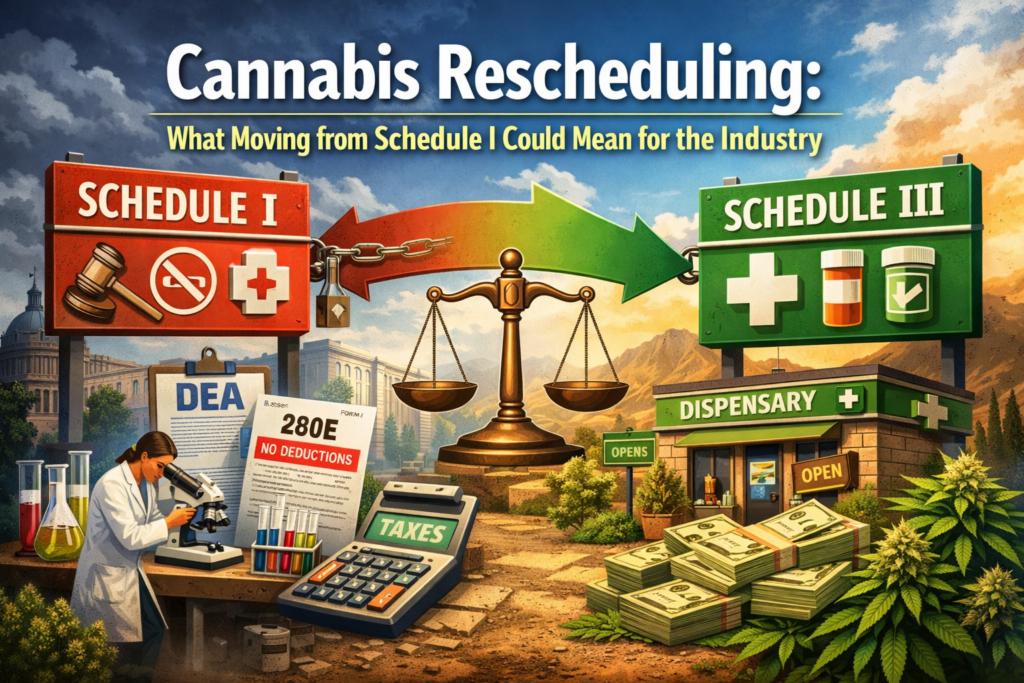
The cannabis industry stands at a historic crossroads. After more than 50 years as a Schedule I controlled substance, marijuana may soon move to Schedule III classification—a change that could reshape everything from business taxes to medical research. For consumers, cultivators, and cannabis businesses like Green Pharms, understanding what this rescheduling means is essential for navigating the evolving legal landscape.
Compliance Disclaimer: This article provides educational information about federal cannabis rescheduling for informational purposes only. It does not constitute legal, tax, or medical advice. Cannabis laws vary by jurisdiction, and individuals should consult with qualified professionals regarding their specific circumstances. Always verify local and state regulations before making cannabis-related decisions. Consult with healthcare providers before using cannabis products, particularly if you have underlying health conditions or take prescription medications.
Understanding Schedule I vs. Schedule III Classification
The federal Controlled Substances Act categorizes drugs into five schedules based on their medical utility, abuse potential, and safety profile. Understanding these classifications helps clarify what rescheduling actually means for the cannabis industry.
What Schedule I Classification Means
Schedule I represents the most restrictive federal drug classification. Substances in this category are defined as having no currently accepted medical use, a high potential for abuse, and unsafe for use even under medical supervision. Currently, marijuana shares Schedule I status with substances like heroin, LSD, and ecstasy.
This classification has created significant challenges for the cannabis industry. Despite widespread state-level legalization for medical and recreational use, federal Schedule I status means marijuana businesses face restrictions that other legitimate industries never encounter. From banking access to tax treatment, Schedule I classification impacts every aspect of cannabis operations.
For researchers, Schedule I status creates substantial barriers. Scientists studying marijuana must navigate exhaustive DEA registration requirements, limited access to research-grade cannabis, and institutional concerns about jeopardizing federal funding. According to data compiled by the Drug Enforcement and Policy Center at Ohio State University, fewer than 600 researchers were registered with the DEA to study any Schedule I substance as of December 2019.
What Schedule III Classification Involves
Schedule III drugs are defined as substances with moderate to low potential for physical and psychological dependence, an accepted medical use, and safer profiles than Schedule I or II substances. This category includes medications like ketamine, Tylenol with codeine, anabolic steroids, and buprenorphine.
Moving marijuana to Schedule III would acknowledge what dozens of states and millions of patients have long recognized: cannabis has legitimate medical applications. The Department of Health and Human Services concluded in its 2023 scientific review that marijuana has currently accepted medical use, with over 30,000 licensed healthcare practitioners across 43 jurisdictions authorized to recommend it for more than 6 million registered patients treating at least 15 medical conditions.
However, Schedule III status doesn’t mean marijuana becomes federally legal for recreational use. It remains a controlled substance with regulatory requirements, just with reduced restrictions compared to Schedule I. Understanding this distinction is crucial for managing expectations about what rescheduling actually accomplishes.
The Path to Rescheduling: Where We Are Now
The journey toward cannabis rescheduling has been years in the making, with significant developments accelerating in 2024 and 2025.
The Review Process
In October 2022, President Biden directed the Department of Health and Human Services and the Drug Enforcement Administration to review marijuana’s scheduling status under the Controlled Substances Act. HHS conducted a comprehensive scientific and medical evaluation, consulting with the FDA and National Institute on Drug Abuse.
In August 2023, HHS recommended that marijuana be rescheduled to Schedule III based on findings that cannabis has accepted medical use and lower abuse potential than Schedule I or II substances. The FDA identified credible scientific support for marijuana’s use in treating pain, anorexia related to certain medical conditions, and chemotherapy-induced nausea and vomiting.
In May 2024, the Department of Justice issued a proposed rule to reschedule marijuana to Schedule III. The proposal attracted enormous public interest, receiving over 43,000 comments—a record for any DEA rule change. Most comments supported descheduling, decriminalizing, or legalizing marijuana at the federal level.
Recent Developments
The rescheduling process faced delays throughout 2025, with hearings postponed multiple times due to administrative and legal challenges. Then, on December 18, 2025, President Trump issued an executive order directing the Attorney General to expeditiously complete the rescheduling process.
The executive order marks a significant policy shift but doesn’t automatically change marijuana’s legal status. Federal agencies must still complete the formal rulemaking process, which includes addressing public comments, conducting required hearings, and issuing a final rule. Legal experts anticipate this process could extend into 2026, though the executive order signals clear administrative priority for completion.
For dispensaries like Green Pharms serving Mesa, Apache Junction, and surrounding Arizona communities, this timeline means continued operation under existing state regulations while preparing for potential federal changes ahead.
Tax Implications: The End of Section 280E
Perhaps no aspect of cannabis rescheduling carries more immediate financial impact than the elimination of Internal Revenue Code Section 280E restrictions.
Understanding Section 280E’s Impact
Section 280E states: “No deduction or credit shall be allowed for any amount paid or incurred during the taxable year in carrying on any trade or business if such trade or business consists of trafficking in controlled substances (within the meaning of schedule I and II of the Controlled Substances Act) which is prohibited by Federal law.”
This provision, enacted in 1982 to prevent drug traffickers from claiming tax deductions, has created punishing tax burdens for state-legal cannabis businesses. While companies can deduct cost of goods sold, they cannot deduct ordinary business expenses like rent, employee salaries, marketing, utilities, insurance, or equipment costs.
The result? Cannabis businesses face effective tax rates that can exceed 70%, far higher than virtually any other industry. Multi-state operators set aside massive reserve funds to cover potential IRS enforcement. One major cannabis company reported a $38 million reserve for 2024 alone, including interest and penalties.
This tax treatment creates competitive disadvantages, limits capital for growth and innovation, and makes it difficult for smaller operators to achieve profitability. At discount pharms and dispensaries throughout Arizona, these tax burdens ultimately affect product pricing and business sustainability.
What Changes with Schedule III
Because Section 280E applies only to Schedule I and II substances, rescheduling marijuana to Schedule III would immediately end this tax penalty. Cannabis businesses could deduct ordinary and necessary business expenses just like any other industry.
The financial impact would be transformative. Cannabis operators could deduct payroll, rent, utilities, marketing expenses, professional services, equipment costs, and other standard business expenses. This change would improve cash flow, reduce effective tax rates, and fundamentally alter profitability calculations across the industry.
However, important questions remain about implementation. The IRS has indicated that until a final federal rule is published, Section 280E continues to apply. Some companies that filed amended returns seeking refunds have been told these claims are not valid until rescheduling is finalized.
Tax professionals recommend that cannabis businesses monitor the Federal Register for the final rule publication date, plan estimated tax payments carefully, consider timing of major expenses, and consult with CPAs experienced in cannabis taxation. The effective date of 280E relief—whether it applies to the full tax year of rescheduling or only prospectively—will significantly impact financial planning.
Beyond 280E: Other Financial Benefits
Tax normalization represents just one financial benefit of rescheduling. The change is expected to reduce institutional stigma surrounding cannabis, potentially unlocking new investment opportunities. Banks, payment processors, and insurance companies that have avoided the sector due to federal Schedule I classification may reconsider their positions.
While rescheduling doesn’t automatically resolve banking challenges—financial institutions will still evaluate risk under the Bank Secrecy Act—it removes one significant barrier to mainstream financial services. The executive order explicitly calls for Congress to advance cannabis banking reform, including passage of the SAFER Banking Act.
For customers using a weed calculator to budget cannabis purchases, improved financial conditions for dispensaries could eventually translate to better pricing, expanded product selection, and enhanced services as businesses reinvest tax savings into operations.
Research and Medical Credibility Impact
Beyond financial implications, rescheduling promises to transform cannabis research and medical acceptance.
Current Research Barriers
Schedule I status has severely constrained marijuana research. Scientists must obtain specialized DEA registrations, navigate restrictive laboratory requirements, and source cannabis only from DEA-registered manufacturers. The bureaucratic complexity has discouraged academic and medical institutions from pursuing cannabis studies, often due to concerns about jeopardizing federal funding or professional reputation.
The closed system requirements mean researchers cannot simply purchase cannabis from state-licensed dispensaries in Apache Junction or other legal markets. Instead, they must use federally approved sources, which historically have provided limited strain diversity and often lower-quality material than what consumers find at legal dispensaries.
These restrictions have created a knowledge gap. While millions of patients use cannabis for various conditions, rigorous clinical data on efficacy, dosing, safety profiles, and potential drug interactions remains limited compared to other widely-used medications.
How Schedule III Changes Research
Rescheduling to Schedule III would substantially reduce research barriers. While DEA registration requirements would still apply, the process would be significantly streamlined compared to Schedule I protocols. Researchers would no longer face the exhaustive approval hurdles that have historically limited cannabis studies.
More importantly, the reduced stigma associated with Schedule III status would signal to universities and hospitals that cannabis research can proceed within federal law without jeopardizing other funding or institutional standing. This could dramatically expand the pool of researchers and institutions willing to conduct cannabis studies.
The executive order specifically directs federal agencies to develop research models using real-world evidence, improve data quality and availability, inform standards of care, support evidence-based policymaking, and accelerate pharmaceutical development. These initiatives could produce the robust clinical safety and efficacy data needed to fully understand cannabis’s therapeutic potential.
However, experts caution that rescheduling alone won’t instantly open the research floodgates. The Medical Marijuana and Cannabidiol Research Expansion Act, enacted in 2022, created specialized procedures for marijuana research that would continue to apply. Sourcing requirements, while potentially less restrictive, will still limit researchers’ ability to use products from state-legal markets.
Medical Credibility and Insurance Coverage
Schedule III status provides official federal recognition that marijuana has accepted medical use. This acknowledgment could significantly impact medical credibility and insurance coverage considerations.
Currently, health insurance typically doesn’t cover cannabis purchases because it’s not an FDA-approved medication. Rescheduling won’t immediately change this—products would still need FDA approval through the standard drug development process. However, enhanced research capabilities could facilitate development of standardized, FDA-approved cannabis medications that would qualify for insurance coverage.
For dispensaries like Green Pharms, increased medical credibility strengthens the educational foundation for serving patients. While state-licensed cannabis products remain distinct from FDA-approved medications, the federal government’s acknowledgment of medical utility validates what dispensary staff and customers have long known: cannabis offers legitimate therapeutic benefits for many conditions.
What Rescheduling Does NOT Change
Understanding what rescheduling doesn’t accomplish is as important as recognizing what it does change.
State Laws Remain Unaffected
Cannabis rescheduling is a federal action that doesn’t alter state-level regulations. In Arizona, where Green Pharms operates, existing state cannabis laws governing licensing, testing, labeling, possession limits, and sales restrictions continue unchanged.
Each state maintains its own cannabis regulatory framework, and these systems operate independently of federal scheduling classifications. Arizona’s medical marijuana program, adult-use recreational sales, and dispensary licensing requirements all remain in effect regardless of federal rescheduling.
This means dispensaries in Apache Junction and throughout Arizona continue operating under Arizona Department of Health Services oversight, with the same compliance requirements they face today. For consumers, state-level rules about purchase limits, possession amounts, and where cannabis can be consumed remain unchanged.
Recreational Use Stays Federally Illegal
Moving marijuana to Schedule III does NOT legalize recreational cannabis at the federal level. This crucial distinction often gets lost in rescheduling discussions.
Schedule III substances are controlled substances with strict regulatory requirements. Unauthorized manufacture, distribution, or possession remains a federal crime. The key change is that Schedule III allows for accepted medical use under appropriate medical supervision, while Schedule I prohibits any legal medical use.
State-legal recreational dispensaries would continue operating under state authority, not federal approval. The tension between state legalization and federal prohibition persists—rescheduling simply reduces certain regulatory and tax burdens without creating federal recreational legalization.
This means cannabis possession and use in states without legalization remains illegal under both state and federal law. Even in legal states, federal employees, individuals in federally-regulated positions, and those subject to federal jurisdiction continue facing cannabis restrictions regardless of rescheduling.
Dispensary Operations Continue Under State Law
Perhaps most importantly for consumers, rescheduling doesn’t bring state-licensed dispensaries into federal compliance. The botanical cannabis products sold at Green Pharms and other state-licensed dispensaries would remain “unapproved new drugs” under the Federal Food, Drug, and Cosmetic Act.
Only FDA-approved cannabis medications like Epidiolex, Marinol, and Syndros can be lawfully prescribed and dispensed through traditional pharmacies under federal law. State-licensed dispensary products lack this approval and would continue operating under state regulatory frameworks rather than federal pharmaceutical regulations.
This means Green Pharms continues serving customers through Arizona’s established dispensary system, with products tested and regulated according to state standards. The dispensary experience—from product selection to purchase process to consumption guidance—remains fundamentally unchanged by federal rescheduling.
Criminal Penalties Partially Persist
While some CSA penalties would be reduced for Schedule III substances, marijuana-specific penalties would remain. For example, quantity-based mandatory minimum sentences established by 21 U.S.C. § 841 would continue applying to marijuana offenses regardless of scheduling changes.
Federal prosecution for unauthorized cannabis activities would remain possible, though enforcement priorities might shift. The medical marijuana appropriations rider that currently shields state-legal medical programs from federal prosecution would continue providing protection only as long as Congress maintains this funding restriction.
How Businesses Like Green Pharms May Benefit
For dispensaries serving Arizona communities, cannabis rescheduling creates several potential benefits and opportunities.
Improved Financial Health
The most immediate benefit comes from Section 280E relief. State-licensed dispensaries could deduct normal business expenses, dramatically improving profitability and cash flow. These savings could be reinvested in staff training and compensation, facility improvements and expansion, product quality and selection, customer education programs, and community involvement.
Better financial health means more stable operations and improved ability to weather industry challenges. For family-owned dispensaries like Green Pharms, tax normalization removes an artificial competitive disadvantage that has nothing to do with product quality or customer service.
Enhanced Access to Financial Services
While not automatic, reduced federal stigma associated with Schedule III status may encourage more financial institutions to provide banking services, payment processing, and insurance coverage to cannabis businesses. This could gradually reduce the industry’s reliance on cash operations, improving convenience for customers and safety for staff.
Credit card acceptance, currently unavailable at most dispensaries, could eventually become standard as payment processors gain confidence in the changing federal landscape. This would particularly benefit customers who prefer electronic payment methods over cash transactions.
Increased Investment and Innovation
Rescheduling signals federal recognition of cannabis’s legitimate place in the medical and commercial landscape. This could attract new investment capital from institutional investors previously deterred by Schedule I classification.
Additional capital enables innovation in cultivation techniques and genetics, extraction and processing technologies, product formulation and delivery methods, quality control and testing procedures, and customer experience enhancements. For dispensaries prioritizing quality like Green Pharms, increased industry investment means access to better products and technologies.
Stronger Medical Programs
Enhanced research capabilities could produce clinical data that strengthens medical cannabis programs. Better understanding of efficacy, optimal dosing, strain-specific effects, and safety profiles would help dispensary staff provide more informed guidance to medical patients.
Insurance coverage for FDA-approved cannabis medications, while years away, could eventually complement dispensary offerings. Patients might receive prescriptions for standardized medications through traditional pharmacies while also accessing diverse product selections at dispensaries for personalized wellness approaches.
Community Standing and Education
Federal recognition of medical utility enhances cannabis businesses’ standing within their communities. Dispensaries can more confidently engage in community education, public health discussions, and local economic development initiatives.
For Green Pharms, serving Mesa, Apache Junction, and surrounding communities with integrity and transparency, reduced federal stigma reinforces the legitimacy of the educational mission. As cannabis knowledge becomes more mainstream and accepted, dispensaries are better positioned as community resources for evidence-based information.
Frequently Asked Questions
Q: When will cannabis rescheduling actually take effect?
A: The timeline remains uncertain. While President Trump’s December 2025 executive order directs agencies to complete rescheduling expeditiously, the formal rulemaking process still requires administrative hearings, public comment responses, and final rule publication. Most experts anticipate completion sometime in 2026, though the exact date depends on agency procedures and potential legal challenges. Until a final rule is published in the Federal Register, marijuana remains Schedule I.
Q: Will I be able to buy cannabis at regular pharmacies after rescheduling?
A: No. Rescheduling to Schedule III doesn’t authorize pharmacies to dispense state-licensed cannabis products. Only FDA-approved cannabis medications like Epidiolex can be prescribed and dispensed through traditional pharmacies. State-licensed dispensaries like Green Pharms in Arizona will continue operating under state regulatory frameworks. The dispensary experience and product availability remain unchanged by federal rescheduling.
Q: Does rescheduling mean I can travel between states with cannabis?
A: No. Interstate transport of cannabis remains federally illegal regardless of scheduling. Even moving between two legal states with cannabis violates federal law. Rescheduling doesn’t change restrictions on interstate commerce or transportation. Cannabis purchased at a dispensary in Apache Junction, for example, can only be legally possessed and consumed within Arizona according to state regulations.
Q: How will rescheduling affect cannabis prices at dispensaries?
A: The impact on consumer pricing is uncertain. Section 280E relief could improve dispensaries’ financial positions, potentially allowing for competitive pricing strategies. However, increased demand from reduced stigma, new taxes or fees that might be implemented, and enhanced product quality from additional investment could offset some savings. At Green Pharms, our commitment to competitive pricing and quality value remains consistent regardless of federal scheduling changes.
Q: Will employers still be able to drug test for marijuana after rescheduling?
A: Yes. Rescheduling doesn’t affect employers’ rights to maintain drug-free workplace policies and conduct marijuana testing. Private employers can continue establishing their own workplace rules regarding cannabis use. Federal employees and those in safety-sensitive positions (like DOT-regulated roles) will continue facing marijuana restrictions. Arizona is an at-will employment state, and employers generally maintain broad discretion over workplace drug policies.
Q: Does this mean medical marijuana will be covered by health insurance?
A: Not immediately. Health insurance covers FDA-approved medications, and state-licensed cannabis products don’t have FDA approval. Rescheduling could eventually facilitate development of new FDA-approved cannabis medications that would qualify for insurance coverage, but this process takes years of clinical trials and regulatory review. For now, cannabis purchases from dispensaries remain out-of-pocket expenses not covered by traditional health insurance plans.
Conclusion: A Significant Step Forward
Cannabis rescheduling from Schedule I to Schedule III represents a historic shift in federal drug policy, acknowledging medical reality and reducing punishing restrictions that have hampered legitimate businesses for decades. For the cannabis industry, the change promises substantial benefits including tax relief, enhanced research capabilities, improved financial access, reduced stigma, and increased investment opportunities.
However, rescheduling is not federal legalization. Recreational cannabis remains federally prohibited, state laws continue governing local operations, and dispensaries like Green Pharms continue operating under state regulatory frameworks. Understanding both what rescheduling accomplishes and what it doesn’t change is essential for managing expectations and planning for the future.
For Green Pharms, serving Mesa, Apache Junction, and the surrounding Arizona communities, our commitment remains constant regardless of federal scheduling: providing high-quality cannabis products, educational resources, and personalized service within Arizona’s legal framework. As a family-owned and operated dispensary, we’re cultivating a different kind of care—one grounded in transparency, integrity, and genuine dedication to our customers’ wellness.
Whether you’re seeking medical cannabis solutions or exploring recreational options, Green Pharms offers carefully curated product selections, knowledgeable staff guidance, and a welcoming environment. Visit us at our Mesa location at 7235 E Hampton Ave STE 115, explore our online menu, or check out our current deals and promotions.
As federal cannabis policy continues evolving, Green Pharms remains your trusted resource for education, quality products, and responsible guidance. The future of cannabis is bright, and we’re excited to continue serving our community through these transformative times.
Final Compliance Disclaimer: This article provides general educational information about federal cannabis rescheduling and potential industry impacts. It does not constitute legal, medical, tax, or professional advice. Cannabis laws are complex and vary by jurisdiction. Individuals and businesses should consult qualified attorneys, tax professionals, and healthcare providers for guidance specific to their circumstances. Cannabis affects individuals differently, and what works for one person may not be appropriate for another. Always consult healthcare professionals before using cannabis, especially if you have medical conditions, take prescription medications, or are pregnant or nursing. The information in this article is current as of the publication date, but regulations and policies may change. Green Pharms makes no warranties about the accuracy, completeness, or reliability of this information and assumes no liability for actions taken based on content herein.
NOTES SECTION (Not Included in Published Blog)
Internal Links Used:
- Green Pharms Homepage (https://greenpharms.com/) – Used when referencing the dispensary location and general brand presence, allowing readers to access main company information.
- Shop Our Mesa Dispensary (https://greenpharms.com/shop-our-mesa-dispensary/) – Used to direct customers to online menu and product selection, relevant when discussing dispensary operations and product availability.
- Deals and Promotions (https://greenpharms.com/deals/) – Referenced in context of pricing and customer value, demonstrating ongoing commitment to competitive pricing regardless of regulatory changes.
External Sources Used:
- Ohio State University – Drug Enforcement and Policy Center (https://moritzlaw.osu.edu) – Comprehensive source for timeline, policy analysis, and rescheduling process details. Provided authoritative overview of DEA and HHS roles in rescheduling.
- NPR – Marijuana Rescheduling Analysis – Detailed reporting on executive order implications, Section 280E impacts, banking challenges, and expert commentary on research barriers.
- White House Executive Order (https://www.whitehouse.gov) – Official text of December 18, 2025 executive order on marijuana rescheduling and cannabidiol research, providing primary source documentation.
- Congressional Research Service (https://www.congress.gov) – Multiple CRS reports on legal consequences of rescheduling, Section 280E implications, and marijuana research barriers.
- Federal Register (https://www.federalregister.gov) – Official documentation of DEA’s May 2024 proposed rule and public comment period information.
- Current Federal Tax Developments – Tax implications analysis of Section 280E, effective tax rate impacts, and IRS position on cannabis business deductions.
- Cornell Law School – Legal Information Institute (https://www.law.cornell.edu) – Primary source text of Internal Revenue Code Section 280E and Controlled Substances Act provisions.
- Marijuana Policy Project (https://www.mpp.org) – Historical context on Section 280E, including Edmondson v. Commissioner case that prompted the law’s creation.
- Various Law Firms (DLA Piper, ArentFox Schiff, Jackson Lewis, Goodwin Law, Vicente LLP, etc.) – Legal analysis of executive order implications, compliance considerations, and employer obligations regarding rescheduling.
- AICPA – Professional accounting organization’s recommendations for IRS guidance on cannabis business taxation during rescheduling transition.
- CBS News – Reporting on executive order signing, Health and Human Services Secretary comments, and industry reaction.
Higher Education Center for Alcohol and Drug Misuse Prevention – Analysis of research implications and DEA registration requirement changes.