

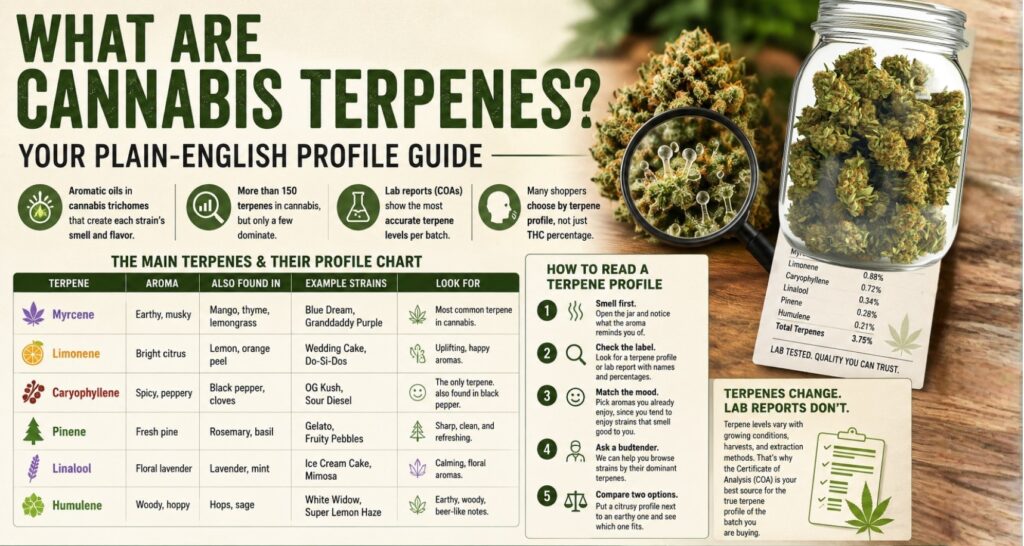
- Terpenes are aromatic oils that give each cannabis strain its smell and flavor.
- Cannabis holds more than 150 terpenes, but only a few dominate.
- Myrcene, limonene, caryophyllene, pinene, linalool, and humulene are the main terpenes.
- A terpene profile chart maps a strain’s leading aromas at a glance.
- Lab reports, or COAs, show the most accurate terpene levels per batch.
- Many shoppers choose by terpene profile, not just THC percentage.
Introduction
Two jars of flower can show the same THC number and still feel like night and day. The clue usually hides in the smell.
That smell comes from cannabis terpenes, the aromatic oils packed into every plant. Once you learn to read cannabis terpene profiles, you shop with a lot more confidence.
We see this every day. GreenPharms is a family-owned dispensary in Mesa, Arizona, and our staff reads these profiles for customers all the time. This guide is for adults 21 and older in Arizona, and it shares education only, not medical advice.
So what are these tiny oils really doing? Let’s start there.
What Are Cannabis Terpenes?
Terpenes are aromatic oils found in cannabis trichomes, the sticky glands that coat the flower. They give every strain its signature scent.
Almost every plant on Earth makes terpenes. They are the reason a lemon smells bright and a pine forest smells sharp.
Cannabis is rich in them. According to a review of cannabis terpene chemistry published through the National Institutes of Health, terpenes are the main compounds behind the plant’s aroma. The same trichomes that hold terpenes also produce cannabinoids like THC and CBD.
The plant can contain more than 150 terpenes in total. Only a handful ever show up in large amounts.
Once you know what they are, the next question is simple. Which ones matter most?
The Main Terpenes and Their Profile Chart
A few terpenes appear again and again. Learning these six gives you a head start on almost any menu.
Think of the chart below as a quick reference. It shows the aroma of each terpene, where else you can smell it in daily life, and a strain or two known for it.
| Terpene | Aroma | Also found in | Example strains |
| Myrcene | Earthy, musky | Mango, thyme, lemongrass | Blue Dream, Granddaddy Purple |
| Limonene | Bright citrus | Lemon, orange peel | Wedding Cake, Do-Si-Dos |
| Caryophyllene | Spicy, peppery | Black pepper, cloves | OG Kush, Sour Diesel |
| Pinene | Fresh pine | Rosemary, basil | Gelato, Fruity Pebbles |
| Linalool | Floral lavender | Lavender, mint | Ice Cream Cake, Mimosa |
| Humulene | Woody, hoppy | Hops, sage | White Widow, Super Lemon Haze |
Myrcene is worth a special note. It is the most common terpene in cannabis and often the dominant one in a profile.
A chart is a great start. But terpenes rarely work alone.
How Terpenes May Work With Cannabinoids
You may have heard of the “entourage effect.” The idea is that terpenes and cannabinoids team up to shape your experience.
It is a popular theory. It is also far from settled.
A 2025 review of the entourage effect through the National Institutes of Health found the synergy remains unproven and calls for more clinical trials. Early research is interesting, but it is not a promise.
That honesty matters when you shop. You can learn more about how cannabinoids and terpenes fit together on our education pages.
Expert Insight: The Number Most Shoppers Watch Is the Wrong One
Many people pick flower by the highest THC percentage on the jar. In our experience on the sales floor, that habit often leads to letdowns. THC measures potency, not the character of your experience. The terpene profile usually does more to shape aroma and feel. Since the entourage effect is still unproven, treat bold claims with healthy skepticism and shop by verified, lab-tested terpene content.
Knowing the theory is one thing. Reading a real label is another.
How to Read Cannabis Terpene Profiles When You Shop
You do not need a science degree to use a terpene profile. You need a short, simple routine.
Here is the process we walk customers through:
- Smell first. Open the jar if you can, and notice what the aroma reminds you of.
- Check the label. Look for a terpene profile or a lab report with named terpenes and percentages.
- Match the mood. Pick aromas you already enjoy, since you tend to enjoy strains that smell good to you.
- Ask a budtender. Our team can browse strains by their dominant terpenes with you.
- Compare two options. Put a citrusy profile next to an earthy one and see which one fits.
This routine beats guessing by THC alone. It also helps you repeat the experiences you like.
One catch trips up most shoppers, though.
Why Terpene Levels Change From Batch to Batch
A terpene profile is not fixed forever. The same strain can smell different from one harvest to the next.
Growing conditions play a big role. Light, temperature, nutrients, and curing all shift the final profile. Even research on minor cannabis terpenes through the National Institutes of Health notes how much these compounds vary across plants.
Extraction matters too. Many terpenes are delicate and burn off under high heat. That is why products like live resin, made from fresh-frozen flower, hold onto more of the original aroma.
So how do you know what you are really getting? Check the certificate of analysis, or COA. This lab report lists the actual terpene and cannabinoid content for that batch.
That brings us to the questions shoppers ask us most.
Cannabis Terpenes FAQ
What are cannabis terpenes? Are aromatic oils made in the plant’s trichomes that give each strain its distinct smell and flavor. Cannabis holds more than 150 of them, though only a handful appear in large amounts.
Are terpenes and cannabinoids the same thing? Are different compounds. Cannabinoids like THC and CBD drive most known effects. Terpenes shape aroma and flavor. Both form in the same trichomes and may interact, though that interaction is still being studied.
Is a terpene profile chart accurate for every batch? Is only a general guide. Terpene levels shift between harvests of the same strain. A current lab report, or COA, gives the most accurate profile for the product in front of you.
Are high-THC strains always the strongest choice? Are not always the best fit. THC measures potency, not experience. Many shoppers find a strain’s terpene profile shapes how it feels, so ask about lab-tested terpenes, not only THC numbers.
Are cannabis terpenes legal in Arizona? Are legal inside state-licensed cannabis products for adults 21 and older. Arizona regulates dispensary products, and lab testing confirms terpene and cannabinoid content before items reach the shelf.
The Bottom Line
Cannabis terpenes are the aroma behind every strain, and they tell you more than a THC number ever will. Learn the main terpenes, read the profile, and you shop like a pro.
The science of how terpenes affect you is still young. This article is for education only and makes no medical claims. Cannabis is for adults 21 and older in Arizona.
For any personal health questions, please talk with a licensed medical professional.
Find Your Profile at GreenPharms
At GreenPharms, our Mesa team helps you read terpene profiles and find products with clear lab results. Stop by the shop or shop our Mesa menu online at greenpharms.com. Bring your questions, and let us point you toward a profile that fits what you are looking for.