
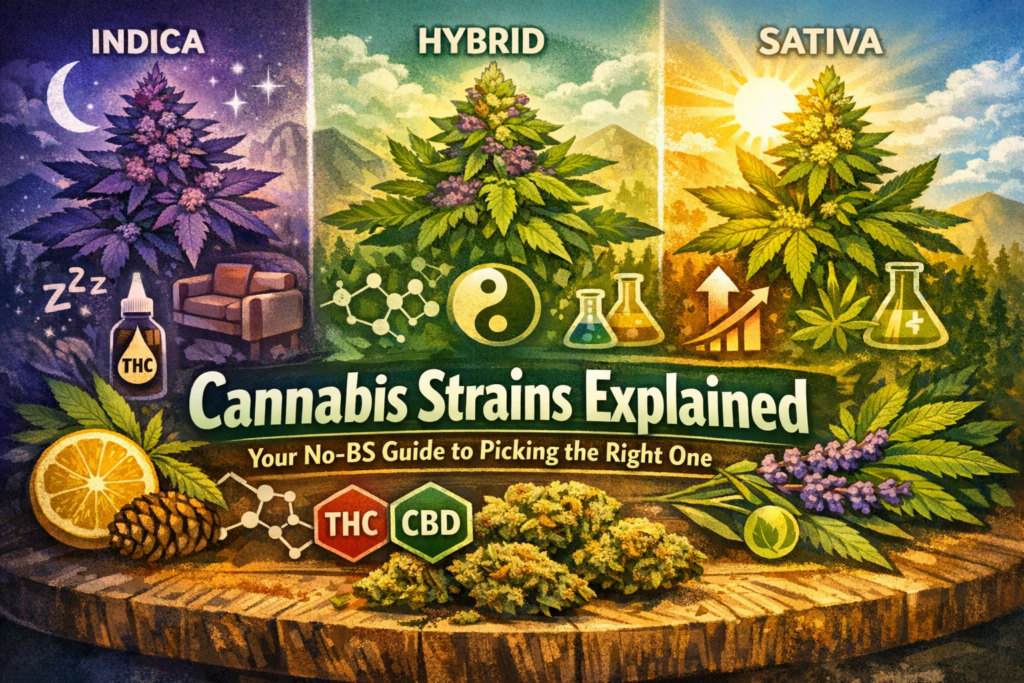
- Cannabis strains are classified as indica, sativa, hybrid, or by terpene profile.
- Indica strains are often associated with relaxing, body-focused effects.
- Sativa strains are commonly associated with energizing, uplifting effects.
- Hybrids blend both and make up most products you’ll find today.
- Terpenes, not just THC, shape how a strain of weed actually feels.
- Checking the full cannabinoid and terpene profile helps you choose more consistently.
You’ve pulled up the menu. There are 80 strains listed. Some sound like desserts. Some sound like science projects. You have no idea where to start.
Sound familiar? You’re not alone. Making sense of marijuana strain information is one of the most common challenges for new and returning cannabis consumers alike. The good news: it’s not as complicated as it looks.
This guide breaks down cannabis strains in plain English. No jargon overload. No guesswork. You’ll learn what indica, sativa, and hybrid labels actually mean, why terpenes matter more than you think, and how to read a strain’s profile before you buy.
For a deeper dive into every category, check out the cannabis strain guide at GreenPharms.
Before you pick a strain at random, here’s exactly what the labels actually mean.
For adults 21 and older. This article is educational only and does not constitute medical advice. New Jersey and Arizona laws apply to all cannabis purchases. Please consult a licensed healthcare provider before using cannabis for any health-related purpose.
What Is a Cannabis Strain?
A cannabis strain is a specific variety of the cannabis plant. Each strain has its own genetic profile. That profile shapes its appearance, aroma, flavor, and its interactions with your body.
Think of it like apples. A Granny Smith and a Honeycrisp are both apples. But they look different, taste different, and feel different when you eat them.
Cannabis breeders create new strains by crossing two parent plants. The resulting offspring inherit traits from both. Over time, this process has produced thousands of distinct cultivars — the more precise word for what most people call “strains.”
Strain names like Blue Dream, OG Kush, or Ice Cream Cake are basically brand names. They give you a starting point. But two batches of the same strain can have different cannabinoid and terpene profiles depending on how and where they were grown.
The names are just the beginning. The chemistry underneath is what really matters.
Indica, Sativa, and Hybrid: What the Labels Really Mean
These three categories are the most common way dispensaries organize cannabis strains. Here’s the quick version.
Indica originated in cooler, mountainous regions like Afghanistan and Nepal. Indica plants grow short and bushy with dense buds. Users traditionally describe indica strains as producing a “body high.” Words like relaxing, calming, and sedating come up often.
Sativa grows tall in warmer climates. Sativa strains are typically described as producing a more energizing, uplifting experience. Creativity and focus are common descriptors.
Hybrid strains are bred from both indica and sativa plants. They come in three main subtypes: indica-dominant, sativa-dominant, and balanced (50/50). Hybrids make up the majority of what’s available at most dispensaries today.
These labels are a helpful starting point. But science is adding important nuance here.
A peer-reviewed study published in Cannabis and Cannabinoid Research found that indica-dominant cultivars were associated with greater low-arousal effects, supporting some of the traditional associations. But the research also highlights that terpene content plays a significant independent role in how a strain feels.
And research published in Nature Plants found that sativa- and indica-labeled samples showed no clear genetic distinction at the genome-wide level. What actually varied between them was terpene content.
That’s where terpenes come in — and they change everything.
Terpenes: The Secret Behind Every Strain of Weed
Terpenes are aromatic compounds found in cannabis and many other plants. They’re why one strain smells like lemons, and another smells like pine or berries.
But terpenes do more than create aroma. According to terpene research published on PubMed, certain cannabis terpenes interact directly with cannabinoid receptors and may enhance or modify the effects of THC and CBD. This interaction is called the entourage effect.
Here are the most common terpenes you’ll encounter and what they’re known for:
| Terpene | Aroma | Commonly Associated With |
| Myrcene | Earthy, musky | Relaxation, sedation |
| Limonene | Citrus | Uplifting mood, energy |
| Linalool | Floral, lavender | Calming effects |
| Caryophyllene | Spicy, peppery | Stress relief, anti-inflammatory research |
| Pinene | Pine, fresh | Focus, alertness |
| Humulene | Earthy, hoppy | Appetite suppression |
A broad review of terpenes in Cannabis sativa published on PubMed confirms that cannabis resin contains hundreds of terpene and cannabinoid compounds, many of which work together in ways science is still working to fully understand.
Once you understand terpenes, you can finally choose a strain with confidence.
Expert Insight: Why “Indica vs. Sativa” Is Only Half the Story
Most shoppers choose a strain based on the label: indica or sativa. But research published in Nature Plants found that sativa- and indica-labeled samples were genetically indistinct at the genome-wide level. What actually drives differences between strains is the terpene profile, the blend of aromatic compounds that interact with cannabinoids to shape your experience. Two strains with identical THC percentages can feel dramatically different because of their terpenes. At a quality dispensary, asking about terpene content gives you more reliable guidance than asking “is this an indica or sativa?”
THC, CBD, and Beyond: The Cannabinoid Profile Breakdown
Cannabinoids are the chemical compounds in cannabis that interact with your body’s endocannabinoid system. THC and CBD are the most well-known. But they’re far from the only ones.
Here are the key cannabinoids found in cannabis strains:
- THC (Delta-9-tetrahydrocannabinol) — The primary psychoactive compound. Responsible for the “high.” Higher THC doesn’t always mean a better experience.
- CBD (Cannabidiol) — Non-intoxicating. Often associated with calming effects. Widely studied for its potential wellness properties.
- CBG (Cannabigerol) — Sometimes called the “mother of all cannabinoids.” Present in smaller amounts. Research is ongoing.
- CBN (Cannabinol) — A mildly psychoactive compound often found in aged cannabis. Studied for its potential sleep-supporting properties.
- CBC (Cannabichromene) — Non-intoxicating. Found in trace amounts. Part of the broader cannabis compounds conversation.
- THCV (Tetrahydrocannabivarin) — Structurally similar to THC but with distinct effects. Present in very small quantities in most strains.
A higher THC percentage does not automatically mean a more enjoyable experience. A strain with 18% THC and a rich terpene profile can feel more balanced and satisfying than a 30% THC product with a flat terpene lineup.
Knowing your cannabinoids is half the battle. Picking the right format is the other.
How to Choose the Right Cannabis Strain for You
Here’s a straightforward process for finding a strain that actually fits your goals.
Step 1: Know your intention. Are you looking to unwind after work? Need a creative boost on a weekend? Want something that doesn’t knock you out? Your goal narrows the field fast.
Step 2: Start low, go slow. If you’re new to cannabis or trying a new strain, start with a low dose. Give your body time to respond before adding more.
Step 3: Look at the full label. Don’t stop at the strain name or THC percentage. Ask for the terpene profile and cannabinoid breakdown. That data tells a much more complete story.
Step 4: Talk to your budtender. A knowledgeable dispensary team member can match you to a strain based on your preferences and experience level. That conversation is one of the most valuable tools available to you.
Step 5: Track what works. Keep a simple note on your phone. Write down the strain name, the terpene profile if you have it, and how it made you feel. Over time, patterns will emerge.
The best strain is the one matched to your goals, and GreenPharms can help you get there.
FAQ
Q: What is the difference between indica and sativa cannabis strains? Indica strains are typically associated with calming, body-focused effects. Sativa strains are linked to more energizing, uplifting experiences. Both labels are useful starting points, though terpene and cannabinoid content shapes effects more precisely than the label alone.
Q: Are terpenes important when choosing a strain of weed? Yes. Terpenes are aromatic compounds that influence how a strain feels, smells, and tastes. Research suggests they interact with cannabinoids to shape your overall experience, so checking a strain’s terpene profile helps you choose more consistently than relying on labels alone.
Q: Is THC percentage the best way to pick a cannabis strain? Not necessarily. THC percentage measures potency, but the full cannabinoid and terpene profile determines the experience. A strain with moderate THC and a specific terpene blend can feel very different from a higher-THC option with a different profile.
Q: Are hybrid cannabis strains better for beginners? Hybrids can be a good starting point because they blend indica and sativa characteristics. A balanced hybrid may feel gentler and more predictable. Always start with a low dose and give yourself time to gauge your response before consuming more.
Q: Is marijuana strain information the same at every dispensary? No. Product availability and strain data vary by dispensary. A quality dispensary like GreenPharms provides information on terpene and cannabinoid profiles and staffs knowledgeable team members who can help match strains to your personal goals.
What Good Marijuana Strain Information Looks Like in Practice
Good strain information doesn’t start and end with a label. It includes the full cannabinoid breakdown, the dominant terpenes, and the context of how and where the plant was grown.
When you walk into GreenPharms, you’re not guessing. You have access to a team that understands the product deeply and a cannabis strain guide built to help consumers at every knowledge level.
Indica, sativa, and hybrid labels give you a starting point. Terpenes and cannabinoids give you the full picture. Combine both, and choosing a strain no longer feels overwhelming.
This article is for educational purposes only. It is intended for adults aged 21 and older. It does not constitute medical advice, and no medical claims are made. Arizona law applies. If you are considering cannabis for a specific health concern, please consult a licensed healthcare provider before making any decisions.
Ready to Find Your Perfect Strain?
GreenPharms makes it easy. Browse the full cannabis strain guide at GreenPharms.com to explore indica, sativa, hybrid, terpene profiles, and more — all in one place. Or stop by the Mesa dispensary at 7235 E Hampton Ave and talk to a team member who can match you to the right strain based on your goals, not just a label. At GreenPharms, we’re cultivating a different kind of care.
External Links Used
| Source | URL | Claim Supported | Status |
| Nature Plants (2021) | https://www.nature.com/articles/s41477-021-01003-y | Sativa/indica genetic indistinctness at genome-wide level | Real, live, credible — peer-reviewed journal |
| PubMed / Scientific Reports (2021) | https://pubmed.ncbi.nlm.nih.gov/33859287/ | Terpenes interact with cannabinoid receptors (entourage effect research) | Real, live, credible — PubMed indexed |
| Cannabis and Cannabinoid Research (2023) | https://pubmed.ncbi.nlm.nih.gov/36648357/ | Indica dominant associated with low-arousal effects; terpene content relevant to subjective effects | Real, live, credible — PubMed indexed |
| PubMed / Terpenes in Cannabis sativa (2019) | https://pubmed.ncbi.nlm.nih.gov/31084880/ | Cannabis resin contains hundreds of terpene and cannabinoid metabolites | Real, live, credible — PubMed indexed |